Collagen wound care dressings help wounds heal by delivering collagen directly to the wound bed, supporting new tissue growth and faster closure. These dressings maintain a balanced, moist environment, do not stick to the wound, and can stay in place for several days, making them ideal for chronic wounds, pressure ulcers, diabetic wounds, and other slow-healing injuries.
Collagen wound care dressings are designed to support your body’s natural healing process by providing the building blocks needed to repair tissue.
Whether you are managing a chronic wound, surgical site, or other skin injury, understanding how to use collagen dressings and when to choose between sheet and particle forms can help improve outcomes and speed up recovery.
What Is a Collagen Wound Care Dressing?
A collagen wound care dressing is an advanced dressing that delivers collagen directly to the wound. Collagen is a key protein your body uses to build new tissue, form skin, and support healing.
When a wound is not healing properly, it often lacks the structure and signals needed to regenerate tissue. Collagen dressings help by creating a supportive environment where new cells can grow and organize.
They also help maintain a moist wound environment, which is essential for healing. Research shows that moisture-balanced wound care can significantly improve healing time and tissue regeneration.
How Collagen Helps With Wound Healing
Using collagen for wound healing supports several important steps in the healing process.
Collagen acts like a scaffold, giving new cells a structure to attach to and grow across. It helps encourage the formation of granulation tissue, which is the healthy tissue that fills in a wound.
It also supports the development of new blood vessels, which are necessary to bring oxygen and nutrients to the wound.
As healing progresses, collagen helps strengthen the new tissue and supports the final stage of closure, where new skin forms over the wound.
Collagen dressings are non-adherent to the wound bed, which reduces trauma and pain upon removal and makes dressing changes simple.
In addition, collagen can help manage enzymes in the wound that may otherwise break down tissue and slow healing.
The Role of MMP Levels in Wound Healing
One of the lesser-known reasons wounds can stall or become chronic is an imbalance in something called matrix metalloproteinases, or MMPs. These are natural enzymes in the body that help break down damaged tissue during the healing process.
In a healthy wound, MMPs play an important role by clearing out dead or damaged tissue so new tissue can form. However, in chronic or non-healing wounds, MMP levels can become too high. When this happens, they begin to break down not only unhealthy tissue, but also newly forming healthy tissue and essential growth factors.
This imbalance can significantly delay healing and keep wounds stuck in an inflammatory state.
Collagen wound care dressings help address this issue by binding to excess MMPs in the wound. By reducing these elevated enzyme levels, collagen creates a more stable environment where new tissue can grow without being broken down too quickly.
This is one of the key reasons collagen for wound healing is so effective, especially in chronic wounds that have not responded to standard treatments.
Key Benefits of Collagen Dressings
Collagen wound care dressings offer several advantages that make them a valuable part of wound management.
They support the growth of healthy tissue and help organize new collagen fibers, which strengthens the wound as it heals. Additionally, they can handle a range of drainage levels, from minimal to heavy, depending on the wound.
Collagen dressings also help remove nonviable tissue over time and support the formation of new blood vessels. Because they conform to the wound bed, they provide consistent coverage and support healing across the entire surface.
They are also useful because they are gentle and non-adherent, meaning they do not stick to the wound bed. This makes dressing changes more comfortable and reduces disruption to newly forming tissue.
Another important benefit is their flexibility. Collagen dressings can be used on a variety of wounds, including those that are infected, necrotic, or slow to heal.
Sheet vs. Particle Collagen Dressings
Collagen wound care dressings come in different forms, and choosing the right one depends on the wound.
A collagen sheet dressing is a flat pad that is placed directly over the wound. It works best for wounds with a more even surface, such as ulcers or surgical wounds. These dressings are easy to apply and stay in place under a secondary dressing.
Collagen particles, also called collagen powder, are more flexible. They can be spread directly into the wound, making them ideal for irregular, shallow, or widespread wounds. Because they can reach areas that flat dressings cannot, they are especially useful when the wound surface is uneven.
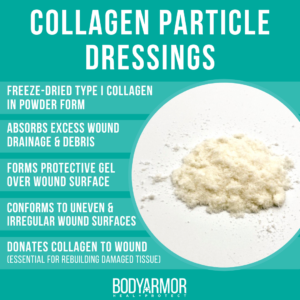
Collagen particles are also commonly used in combination with other treatments like hydrogel, medical-grade honey, or enzymatic debriders to enhance healing. They are a strong option for wounds with moisture-related skin damage, where maintaining balance is important.
How to Apply a Collagen Wound Care Dressing
- Clean the wound using saline or an appropriate wound cleanser and gently pat the surrounding skin dry with gauze.
- Apply the collagen dressing directly to the wound. If using a sheet, lay it flat across the wound bed. If using particles, spread them evenly across the surface.
- For dry or minimally draining wounds, the dressing may be lightly moistened to activate it.
- Cover with a secondary dressing such as foam or gauze to secure.
- Leave the dressing in place for up to 7 days, depending on drainage and provider guidance.
When to Use Collagen Wound Care Dressings
Collagen dressings are best used for wounds that are not healing as expected or need additional support to move forward.
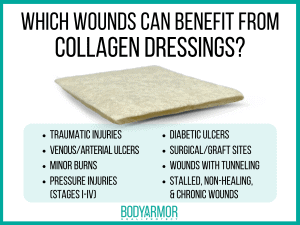
They are commonly used for chronic wounds, pressure injuries, diabetic ulcers, surgical wounds, and wounds with tissue damage or delayed healing.
They can also be used on wounds with some drainage, as they help maintain moisture balance while supporting tissue growth.
Important Considerations
While collagen dressings are highly effective, they should be used as part of a broader wound care plan. It is important to monitor the wound regularly and adjust treatment as needed.
If signs of infection appear, such as increased redness, swelling, or drainage, additional treatment may be required.
Proper application and consistent follow-up are key to getting the best results.
Frequently Asked Questions
If you’re considering using a collagen wound care dressing, you may have questions about how it works and when it’s the right choice. Here are some common questions to help guide your wound care decisions with confidence.
How often should a collagen wound care dressing be changed?
Collagen dressings can often stay in place for several days, typically up to 5-7 days, depending on the level of drainage and the condition of the wound.
Can collagen dressings be used on infected wounds?
Yes, collagen dressings can be used on infected wounds, and are often combined with antimicrobial treatments to address the infection.
What is the difference between collagen sheets and collagen particles (powder)?
Collagen sheets are best for flat, surface-level wounds, while collagen particles or powder are better for irregular or widespread wounds where coverage is needed in multiple areas.
Does topical collagen actually speed up wound healing?
Collagen supports the body’s natural healing process by providing structure and promoting tissue growth, which can help wounds heal more efficiently when used appropriately.
Shop Collagen Wound Care Dressings at Body Armor Medical
If you are looking for a high-quality collagen wound care dressing, Body Armor Medical offers reliable options designed to support real healing.
Our collagen dressings contain type 1 collagen derived from 100% bovine (cattle) collagen membrane. Options include individually wrapped sterile sheets for easy application and collagen particles for versatile coverage.
Both are designed to promote healthy tissue growth, manage moisture, and support wounds that need an extra push to heal.
Whether you are treating a stubborn chronic wound or looking to improve healing outcomes, our products are built to deliver dependable results in both home and clinical settings.
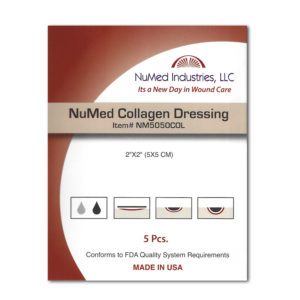
Our collagen sheet dressings are non-adhesive pads that provide excellent moisture control while providing the healing benefits of collagen. Use these on stubborn chronic wounds that continue to drain and need that extra healing boost from collagen.
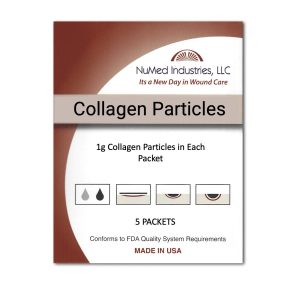
Collagen particles (also known as collagen powder) are of the best kept secrets of wound care professionals!
Collagen particles can be spread generously over nearly any wound and covered with a protective dressing. Collagen powder is extremely versatile and can be combined with hydrogel, medical honey, or Santyl for additional healing benefits of collagen.
Collagen particles are an excellent choice for wounds with surrounding moisture associated skin damage (MASD).
Shop Collagen Dressings


 BodyArmor
  April 12, 2026
  8 Minutes